API Service Keys & MCP
Oneleet’s API provides a programmable interface to your data. Use service keys for AI agent automation, MCP servers, and scripts to interact with your Oneleet workspace. Service keys are decoupled from user accounts and can be scoped for specific tasks.
Configuring an API service key
Section titled “Configuring an API service key”Tenant Admins can create new API service keys. To create one:
-
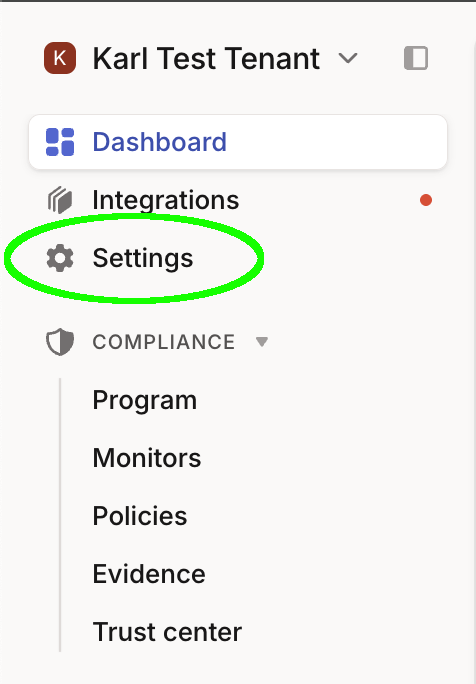
Click Settings in the left panel.
-
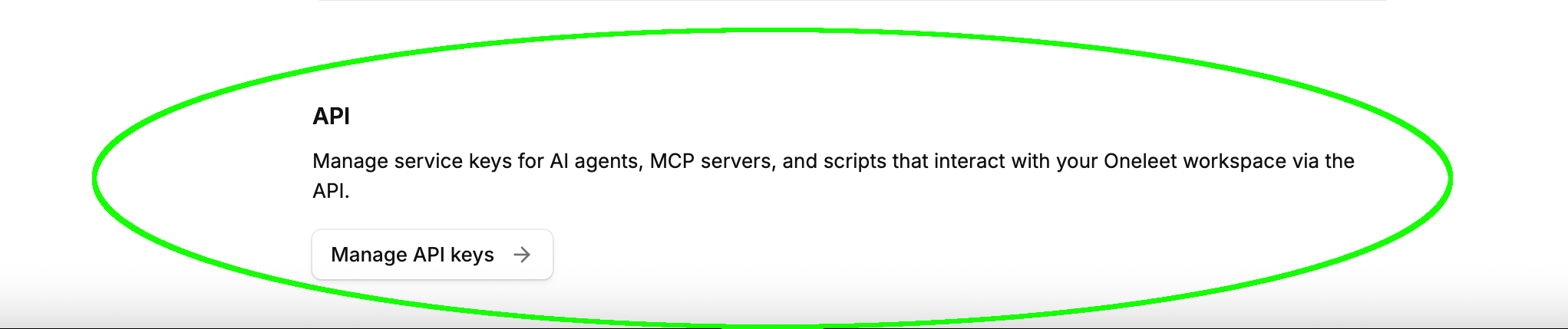
Scroll down to the API section and click Manage API keys.
-
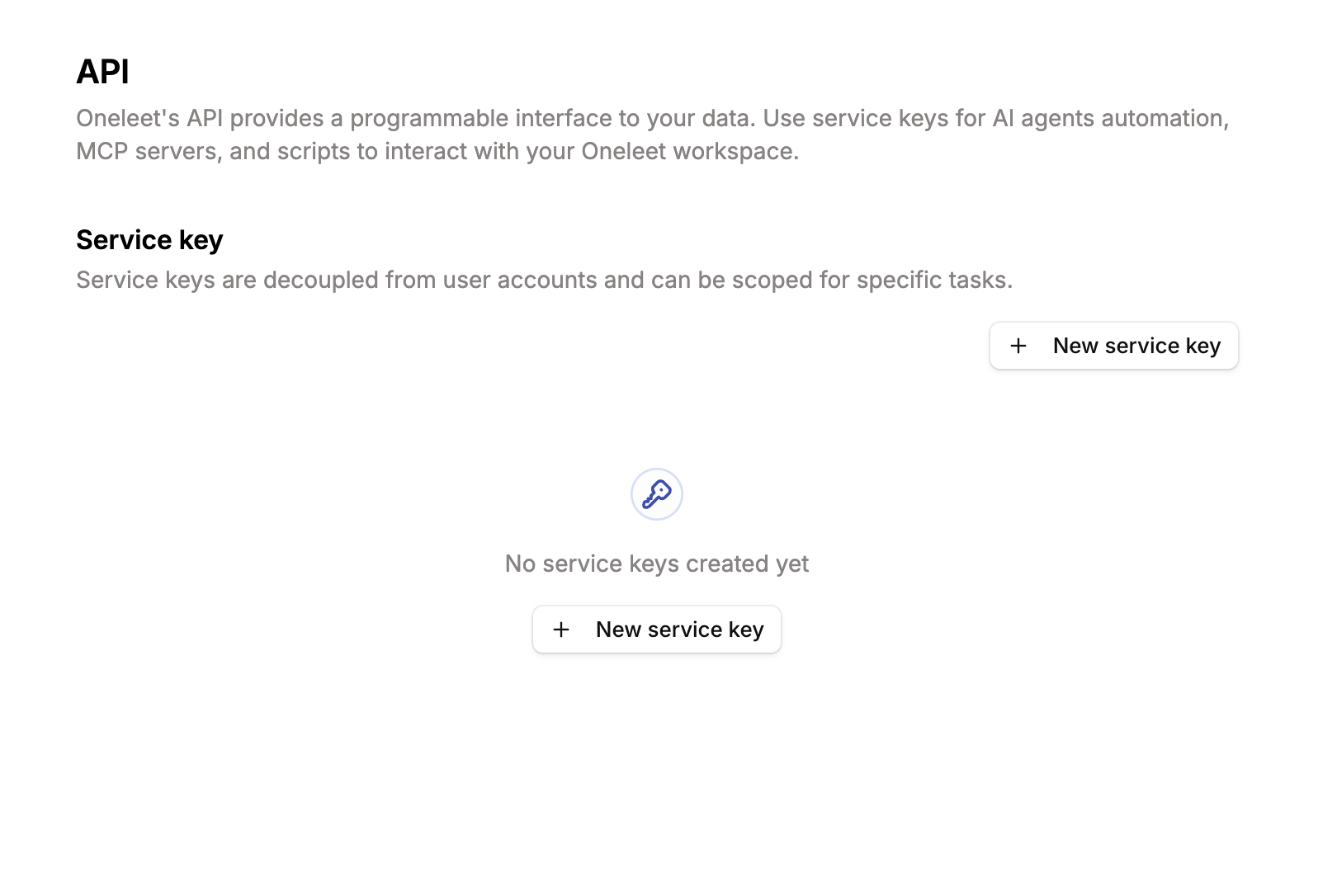
You’ll be greeted by the API service keys settings page.
-
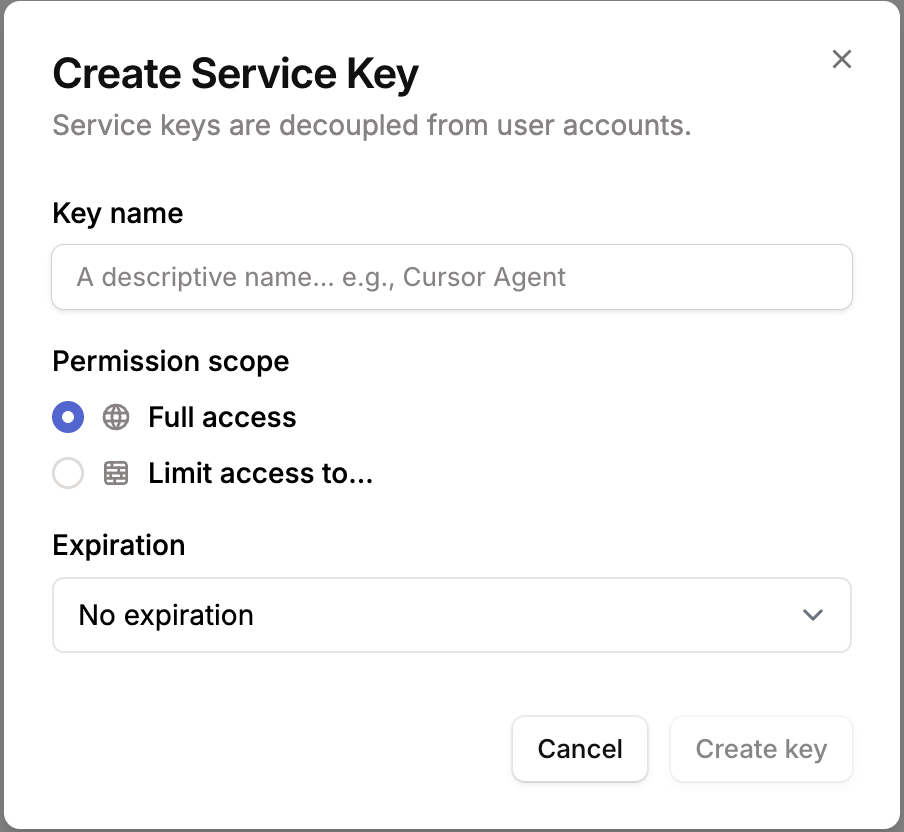
Click New service key to open the Create Service Key modal.
-
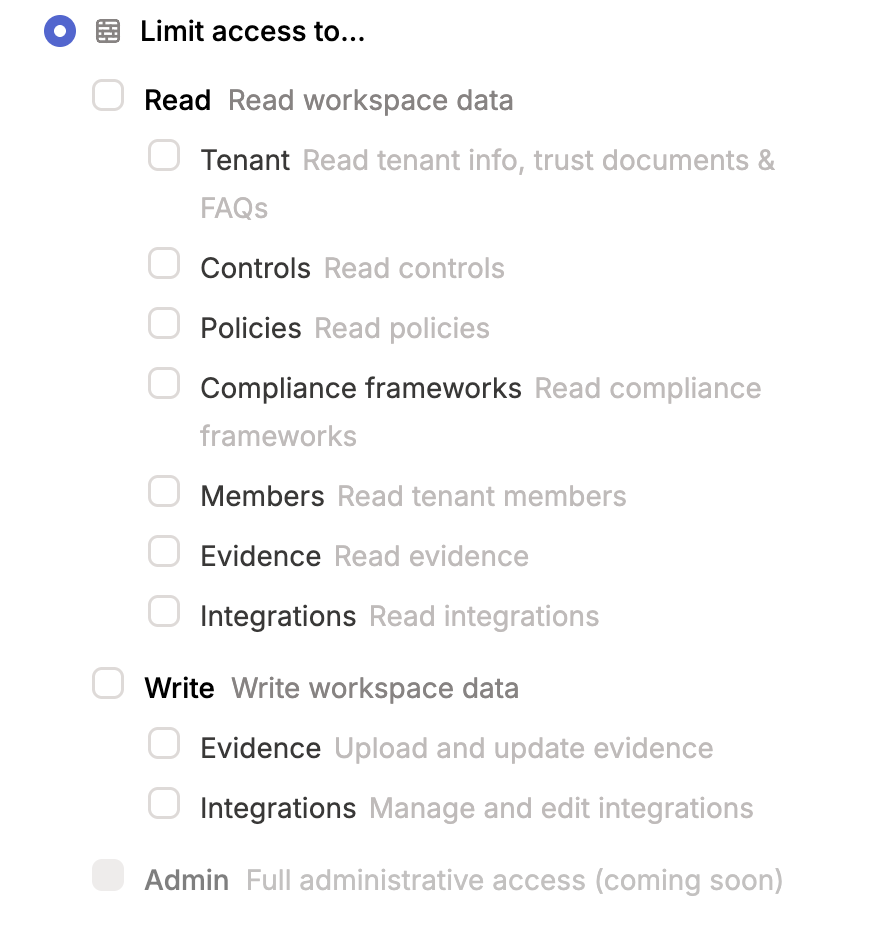
Choose a permission scope. Grant Full access to all tenant service-key scopes, or choose Limit access to… to grant only specific scopes. Tenant keys don’t grant access to the auditor API.
-
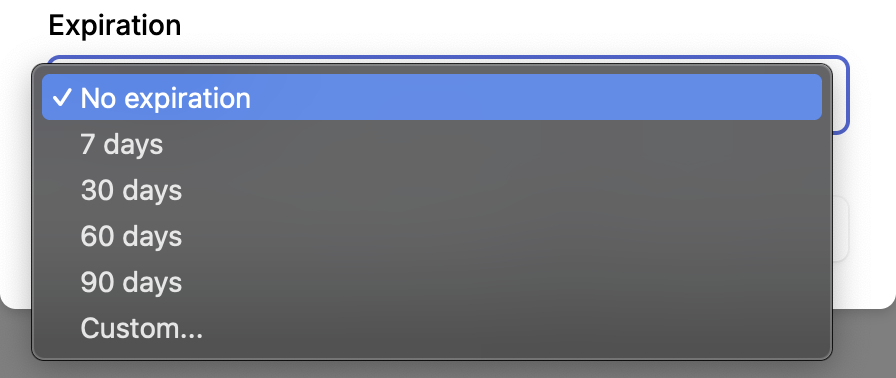
Choose No expiration or select an expiration from the dropdown.
-
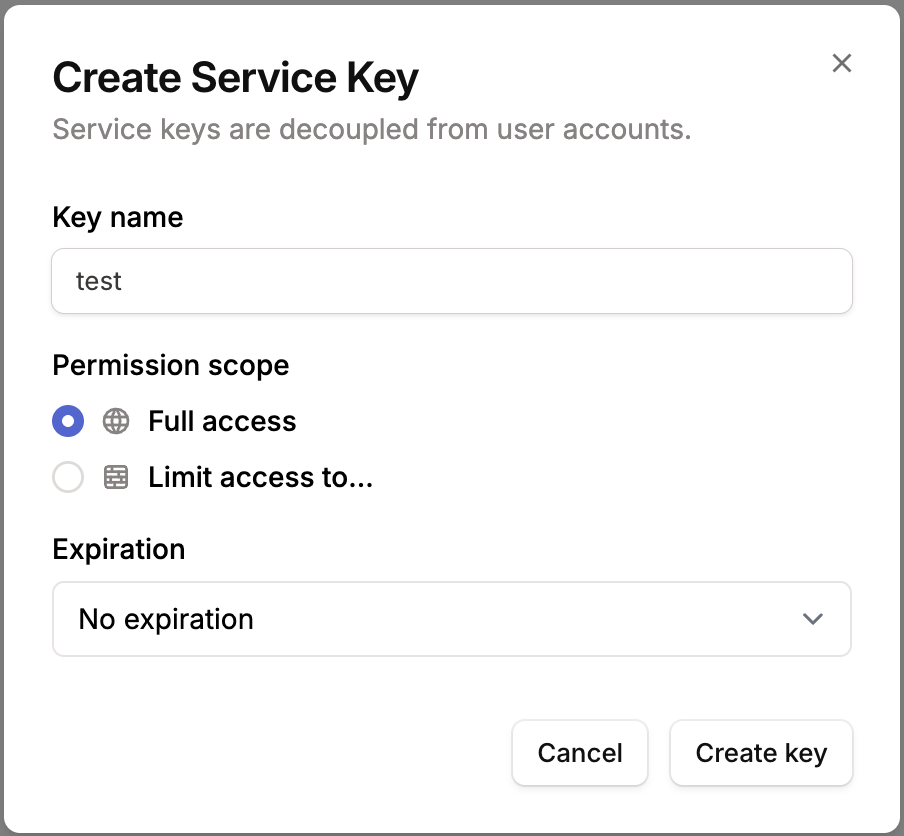
Give the key a name and click Create key.
-
Copy the secret value now. It will not be available after you click away from this screen — the secret is not stored on any system and cannot be retrieved later.
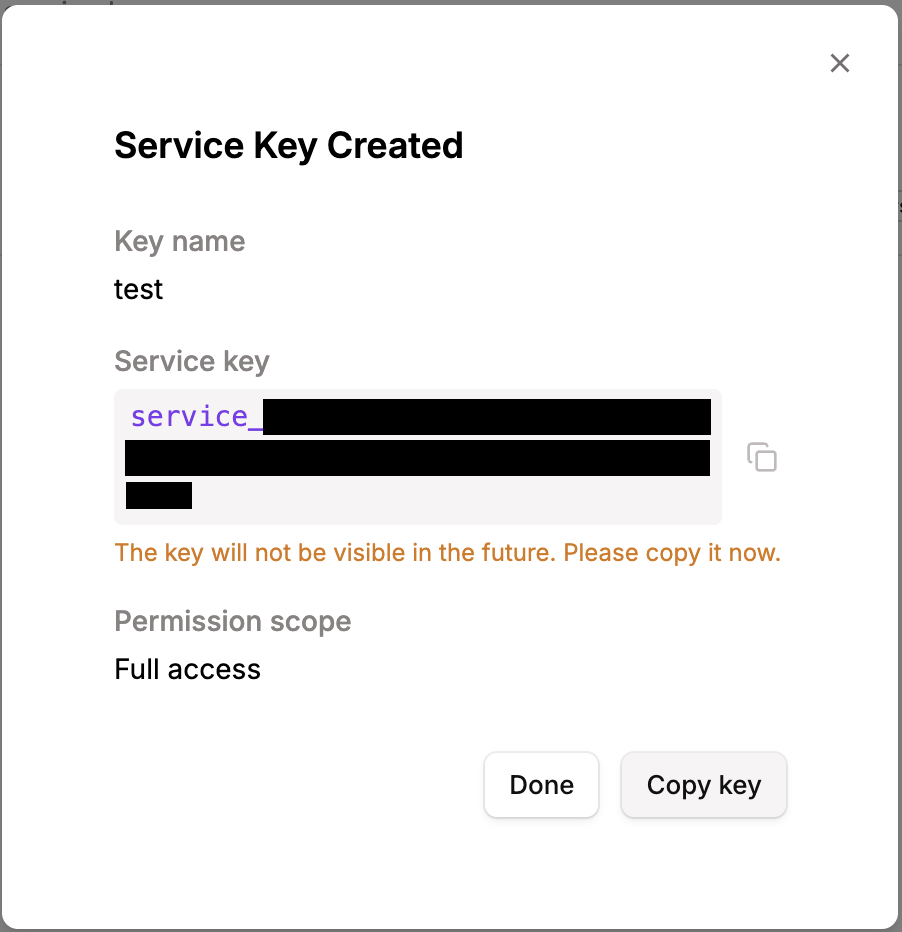
Important: The secret is shown only once, at creation. Store it somewhere safe (such as a secrets manager) before clicking Done — it can never be retrieved again.
-
After clicking Done, the new key appears in the list of API service keys.

Editing and revoking a key
Section titled “Editing and revoking a key”Click the menu (⋯) on a key to edit it — you can change scopes or add an expiration date — or to revoke it.
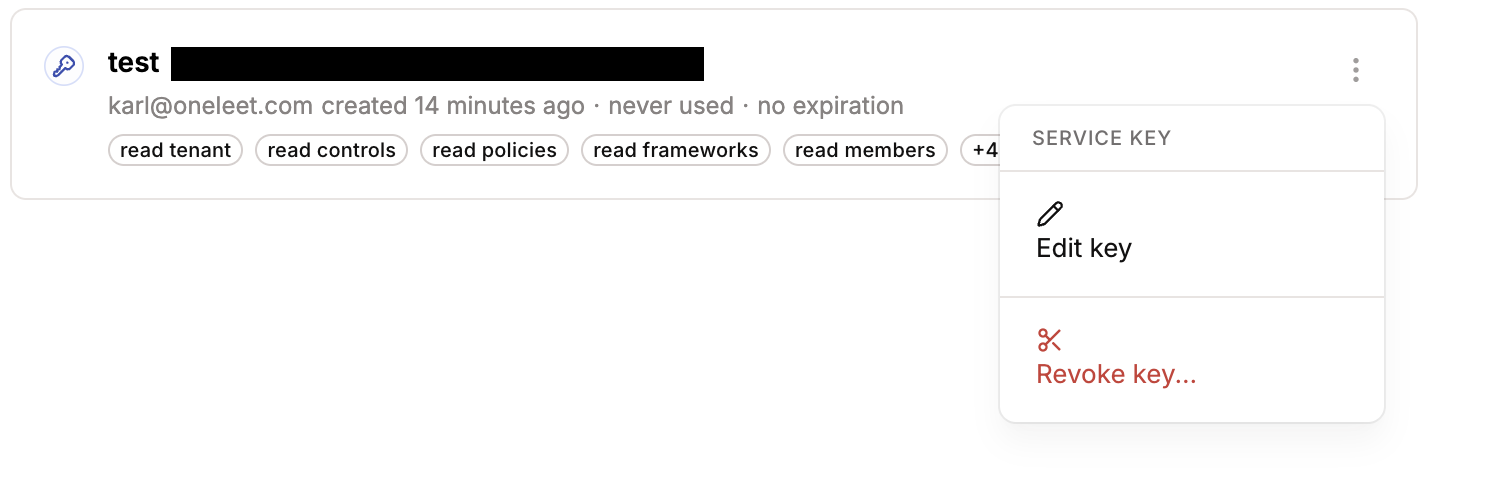
Revoking a key requires you to type the key’s name before the Revoke button is enabled, as this operation cannot be undone from the UI.
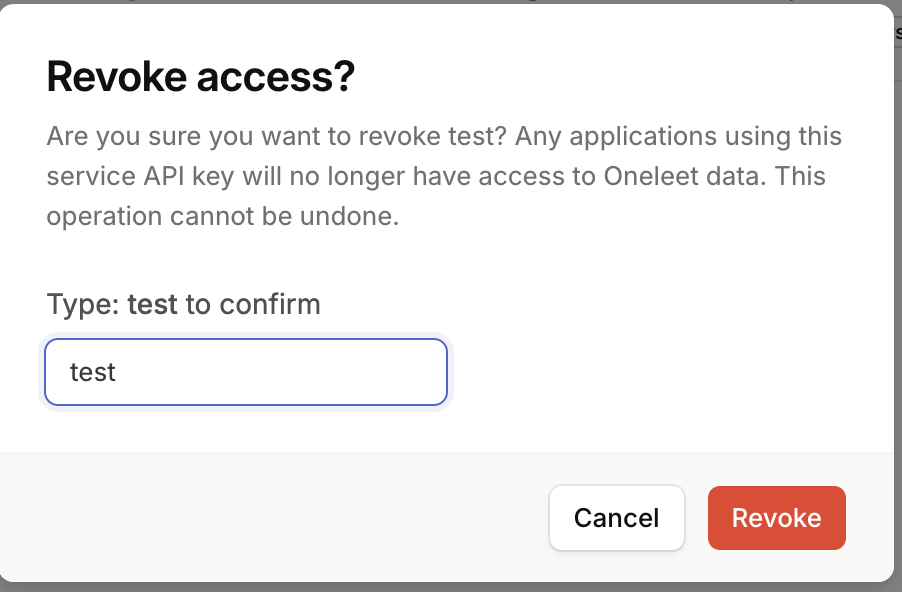
Immediately after revocation, the key is no longer authorized to make successful requests against the API, and it appears as revoked in the UI.

Using your API service key
Section titled “Using your API service key”An API service key can be used to:
- Connect to the Oneleet MCP server from an LLM client (Claude Code, Claude Desktop, Codex, Cursor, etc.).
- Authenticate HTTP requests directly via Bearer token authorization from any HTTP client (curl, Postman, Insomnia, etc.).
Unlike OAuth sign-in, a service key is not tied to a user: requests are attributed to the key, and the key’s scopes are the only permission check.
API specifications and references
Section titled “API specifications and references”Tenant and auditor integrations have separate OpenAPI specifications and interactive references:
| Integration | API reference | OpenAPI JSON |
|---|---|---|
| Tenant workspace | Main API reference | Main API specification |
| Audit firm | Auditor API reference | Auditor API specification |
You can import the relevant specification into Postman or use it to generate an API client. Both APIs use https://api.oneleet.com as their base URL. Each operation documents its required scope.
The main API supports tenant service keys and MCP OAuth access tokens. Auditor integrations require an audit-firm service key, sent as Authorization: Bearer <service-key>, and the firm’s ID for the /api/v1/audit-firms/{audit-firm}/audit-portal/ routes. Tenant keys and MCP OAuth tokens can’t access these routes.
The auditor specification covers audit listings, controls and reviews, published policies, evidence downloads and requests, messages, auditor assignments, and snapshot exports. It excludes internal routes used only by the web application.
Reading security scans and findings
Section titled “Reading security scans and findings”For an automation that reads security results, grant only the read permissions it needs:
| Permission | Data available through MCP |
|---|---|
Attack Surface (READ_ATTACK_SURFACE) |
Scan history and details, issues, and detailed findings |
Application Security (READ_DAST) |
Applications, scan history, issues with their findings, and individual finding details |
Code Security (READ_CODE_SECURITY) |
Findings with source locations and remediation details, plus repository scan status |
Edit an existing service key to add these permissions, then refresh your MCP client’s tool list. Previously created keys, including keys created with Full access, do not automatically receive new permissions. The corresponding security features must also be enabled for your workspace.
Start with NgAttackSurfaceIssueList, DastIssueList, or CodeSecurityFindingList. Use the returned IDs with NgAttackSurfaceFindingGet or DastFindingGet for finding details. Read scan status with NgAttackSurfaceScanList, DastScanList, or TenantGetCodeSecurityScanInfo. The tenant is selected from your service key automatically.
These permissions allow reading existing results. They do not grant permission to trigger scans, update findings, or generate fixes. The results are structured data for your automation; downloadable report archives are not included in these tools.
MCP rejects responses larger than 1 MiB. Application Security issue lists and Code Security finding lists currently return all matching results without pagination; use the REST API for these lists if they exceed the MCP limit.
MCP support — architecture overview
Section titled “MCP support — architecture overview”What is MCP?
Section titled “What is MCP?”MCP (Model Context Protocol) is an open standard created by Anthropic that lets AI assistants (like Claude) interact with external tools and data sources in a structured, secure way. Think of it as a universal adapter that lets AI agents read from and write to business applications without custom integration work per AI tool.
What does Oneleet’s MCP support enable?
Section titled “What does Oneleet’s MCP support enable?”Oneleet exposes a subset of its API as MCP tools, allowing AI assistants to directly interact with compliance data.
Using Oneleet MCP, you can connect Claude (via Claude Desktop, Claude Code, or custom agents), Codex, Gemini, or other LLM assistants to your Oneleet workspace, and use natural language to:
- Browse compliance controls and their status, including per-control checks and activities, and controls broken down by compliance framework or requirement
- View and manage evidence (including uploading files)
- Read policies across compliance frameworks
- List integrations and configure new ones
- Inspect compliance frameworks the tenant is enrolled in, and their requirements
- View and manage monitors — inspect runs and results, rerun, enable/disable, snooze, and set ignore status for failing assets
- View tenant members and tenant details
- View pentest findings and their full details (severity, remediation, and affected targets)
- Manage your vendor directory — list, delete, and restore vendors, read and update vendor risk assessment answers, and maintain each vendor’s data inventory
- Manage your risk register — read, create, update, and archive risks and risk assessments (requires the Risk Management feature)
- Run access reviews — read reviews, update accounts, sync accounts from integrations, and mark vendors as reviewed
- Manage dependency scanning — browse dependency scanning packages and their vulnerabilities, check scan status, start new scans, and update findings (e.g., set resolution status)
- Handle trust center access requests — list document access requests submitted through your trust page and approve or deny them
Just tell your LLM assistant, “show me all my SOC 2 controls that are failing,” or “upload this evidence document for control AC-1”.
How it works
Section titled “How it works”-
Create a service key in Settings → API, choosing which scopes the key should have.
-
Configure your AI assistant with the Oneleet MCP server URL and the service key.
-
When the AI needs compliance data, it calls the appropriate MCP tool — the Oneleet server authenticates the request, checks permissions, executes it against the real API, and returns the result.
Authentication & security
Section titled “Authentication & security”| Feature | Detail |
|---|---|
| Auth method | Service key tokens (service_<id>_<secret>) — separate from user login credentials |
| Secret storage | Only a SHA-256 hash is stored; the raw secret is shown once at creation and never again |
| Tenant isolation | Each service key is bound to exactly one tenant. Cross-tenant access is impossible. |
| Scope-based permissions | Keys are granted specific read/write scopes (e.g., READ_EVIDENCE, WRITE_INTEGRATIONS). The AI can only access what the key allows. |
| Scoped tool catalogue | The tool list the AI sees contains only the tools the key’s scopes allow; a call to any other tool is refused. |
| Expiration & revocation | Keys can have an expiration date and can be revoked instantly from the UI. |
| Validation on every call | Expiration, revocation, and scope are checked on every single MCP call. |
Available permission scopes
Section titled “Available permission scopes”Scopes available as of 2026-09-29:
| Scope | Access |
|---|---|
READ_TENANT |
View tenant details, trust documents, FAQs, dashboards, readiness, compliance journey, and notification defaults |
READ_CONTROLS |
View compliance controls, their checks and activities, and the control program |
READ_POLICIES |
View policies, their versions and signatures, policy templates, and policy types |
READ_TENANTCOMPLIANCEFRAMEWORKS |
View enrolled compliance frameworks and their requirements |
READ_TENANTMEMBERS |
View team members, groups, pending invites, and member checklists |
READ_INTEGRATIONS |
View integrations, their connection asset statuses, and status messages |
READ_EVIDENCE |
View evidence items and their download links |
READ_MONITORS |
View monitors and their runs and results |
READ_PENTESTFINDINGS |
View pentest findings and their details |
READ_VENDORS |
View vendors, discoveries, risk assessments, data inventories, vendor accounts, and vendor requests |
READ_RISKS |
View risks and risk assessments¹ |
READ_ACCESSREVIEWS |
View access reviews, their vendors, accounts, and attachments |
READ_DEPENDENCY_SCANNING |
View dependency scanning packages, vulnerabilities, and scan status |
READ_DEVICES |
View devices, their reported OS and hardware, agent versions, and device monitors⁷ |
READ_TRUST_CENTER |
View trust center configuration, security issues, and document access requests |
READ_FEATURE_FLAGS |
View which features are turned on for the tenant |
READ_ATTACK_SURFACE |
View attack surface scan history, issues, and findings |
READ_DAST |
View applications, scan history, issues, and finding details |
READ_CODE_SECURITY |
View code security findings and repository scan status |
WRITE_EVIDENCE |
Create and upload evidence |
WRITE_INTEGRATIONS |
Create and modify integrations |
WRITE_MONITORS |
Rerun, enable/disable, and snooze monitors; set ignore status for assets |
WRITE_GIT_REPOSITORY_CONTENTS |
Queue code security scans, generate fix patches, and open pull requests⁶ |
WRITE_VENDORS |
Delete and restore vendors; edit assessments and data inventories³ ⁴ ⁵ |
WRITE_RISKS |
Create, update, archive, and delete risks and risk assessments¹ |
WRITE_ACCESSREVIEWS |
Create, update, and complete access reviews² |
WRITE_DEPENDENCY_SCANNING |
Update dependency scanning findings and start new scans |
WRITE_TRUST_CENTER |
Approve and deny trust center document access requests⁸ |
¹ Risk scopes require the Risk Management feature to be enabled for your workspace.
² Marking a vendor as reviewed (access-review-vendor:update:mark-as-reviewed) accepts a file attachment and is therefore available over direct HTTP only, not as an MCP tool.
³ Vendor deletion is a soft delete: the vendor disappears from lists, but its assessment answers, notes, evidence links, and data inventory are preserved. Restore a deleted vendor with POST /api/v1/tenant-vendors/{id}/restore (also exposed as an MCP tool), or by re-adding the same vendor — the bulk upsert restores the original record rather than creating a new one. Pass includeDeleted=true to the vendor list to see deleted vendors.
⁴ Creating vendors and bulk-replacing vendor records remain disabled through the public API and MCP server. To update a vendor’s risk assessment, use the answers-only assessment endpoint (GET/PATCH /api/v1/tenant-vendors/{id}/assessment, also exposed as MCP tools): the server owns the questionnaire structure and validates every answer against its question, so agents can update answers without any risk of corrupting the questionnaire itself. Answering every question marks the review complete, but does not assign a risk level — the vendor stays under Needs details in the Vendors list (and has no risk field in API responses) until someone sets a risk level. Opening the vendor’s assessment page as a workspace admin applies the suggested risk level (derived from the answers) automatically.
⁵ A vendor’s data inventory lists what data it stores or processes, one item per kind of data, each with a sensitivity level and tags. To fill it in through the API or MCP: answer stores_data = yes on the assessment, list the data inventory tags (GET /api/v1/tenants/{tenant}/data-inventory-tags), then create one item per kind of data (POST /api/v1/tenants/{tenant}/vendors/{tenant-vendor}/data-inventory, also exposed as MCP tools). Tagging an item with the system PII or PHI tag marks the vendor as processing personal data. Creating the first item switches a data-storing vendor to inventory mode and completes its review; deleting the last item makes the review incomplete again. Whether an item is shown on the Trust Center stays app-only.
⁶ Queueing a code security scan, generating a patch for a code security finding, and generating dependency bump patches all change state in your workspace, so they require WRITE_GIT_REPOSITORY_CONTENTS, the same scope that opening a pull request needs. These three operations used to require READ_GIT_REPOSITORY_CONTENTS. That scope no longer grants anything and is no longer offered when you create or edit a key; existing keys keep it until they’re next edited. A key or OAuth connection that relied on it for these operations gets a missing-scope refusal, and no longer sees them in its MCP tool list, until WRITE_GIT_REPOSITORY_CONTENTS is added. A key holding only READ_ scopes can’t call any operation that changes state.
⁷ Device reads require the Oneleet Agent feature to be enabled for your workspace. Bearer-authenticated device lists are paginated and include archived devices; see Read devices and agent versions.
⁸ Approving a request emails the requester a download link, so the document must have a file attached (a policy PDF, evidence file, audit report, or pentest report). Only pending requests can be approved or denied.
Connecting an MCP client
Section titled “Connecting an MCP client”The steps below connect a client with a service key. Clients that support OAuth sign-in (Claude, ChatGPT, Claude Code, Codex, Cursor, Devin) can instead be connected without any key. OAuth sign-in is in early access and is enabled per workspace. See Connecting AI assistants with OAuth.
-
Go to Settings → API in the Oneleet dashboard.
-
Create a service key, name it, select the desired scopes, and optionally set an expiration (see the walkthrough above).
-
Copy the generated token (shown only once).
-
Add the Oneleet MCP server to your AI tool’s configuration:
- URL:
https://api.oneleet.com/mcp - Transport: Streamable HTTP
- Auth: Your service key secret (
service_<id>_<secret>) in theAuthorizationheader, with or without aBearerprefix
- URL:
Add it from your terminal. Use --scope user to make it available in every project rather than just the current one:
claude mcp add --transport http --scope user oneleet https://api.oneleet.com/mcp --header "Authorization: Bearer <your-service-key>"Or add it to .mcp.json in your project root:
{ "mcpServers": { "oneleet": { "type": "http", "url": "https://api.oneleet.com/mcp", "headers": { "Authorization": "Bearer <your-service-key>" } } }}Add it to .cursor/mcp.json in your project root, or configure it via Cursor Settings > MCP:
{ "mcpServers": { "oneleet": { "url": "https://api.oneleet.com/mcp", "headers": { "Authorization": "Bearer <your-service-key>" } } }}Use this configuration with any MCP-compatible client. The Oneleet MCP server uses Streamable HTTP transport:
{ "name": "oneleet", "transport": "streamable-http", "url": "https://api.oneleet.com/mcp", "headers": { "Authorization": "Bearer <your-service-key>" }}Replace <your-service-key> with the token shown after creating a service key.